

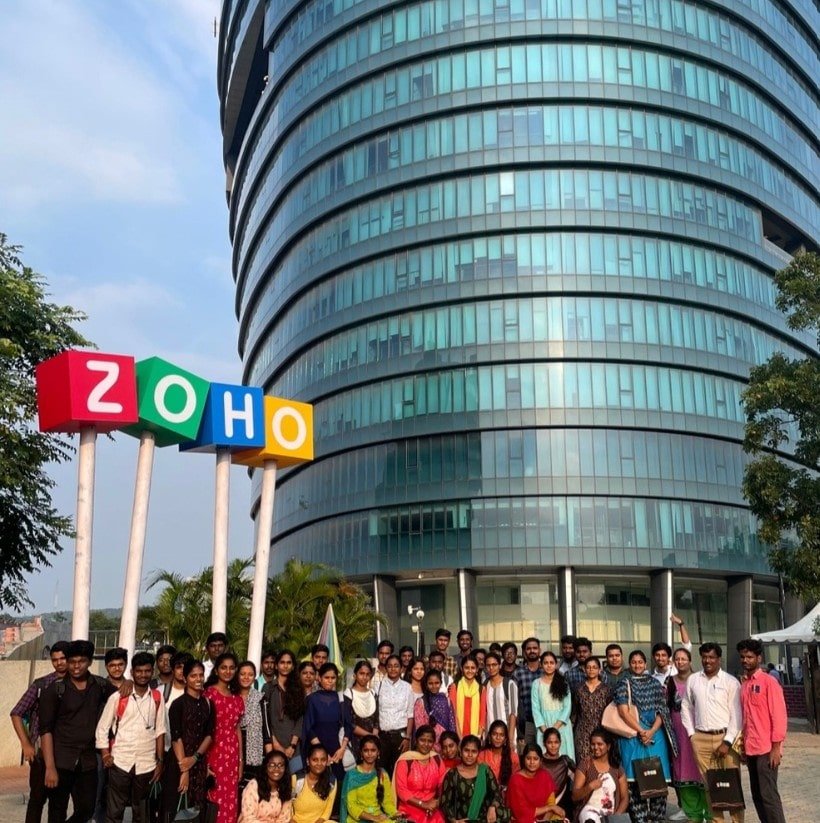
Zoho: India’s Tech Rival to Microsoft & Google

Nowadays, the world is dominated by various tech giants like Microsoft, Google, and Salesforce. It’s easy to believe that innovation and enterprise software will always come from the U.S. or other Western hubs. Not anymore!
Zoho Corporation, an Indian company, has gradually build a global SaaS empire. It is becoming one of the best alternatives to years old tech giants. From a modest beginning to a high-tech enterprise software, Zoho’s journey shows that India is capable of competing with various big companies.
Who is the founder of Zoho?
Zoho’s story begins in 1996 when Sridhar Vembu and Tony Thomas founded the company (originally called AdventNet) in Pleasanton, California. While their initial focus was on network management tools, over time their vision expanded. Sridhar especially believed that India had abundant engineering talent. He aimed to improve infrastructure and environment to produce world-class software products.

Though founded in the U.S., the brand was deeply rooted in India. As the team expanded, they started building more operations and engineering teams in Indian cities. Eventually, Sridhar shifted his major operations to rural areas in Tamil Nadu. It helped in cost savings and creating new models of work. It helped in empowering underserved areas and reimagining how a global software company could function.
The Vision of Sridhar Vembu
Sridhar Vembu studied at IIT Madras and PhD from Princeton. He believed in building sustainable growth rather than chasing quick success. He also saw potential in rural India. He believed that India was as a source of talent, innovation, and purpose.
It has set up offices and development centers in places like Tenkasi and Kallakurichi in Tamil Nadu. Here local graduates are trained, mentored, and helped in getting good jobs in technology sector. Vembu’s leadership emphasizes quality, long-term thinking, minimal external dependencies and aligning product decisions with customer value.
Zoho’s Unique Business Model
Here are the core pillars that make it distinct:
100% Bootstrapped: It has largely avoided external venture capital. This gives them freedom over product roadmap, pricing decisions, and privacy policies. They are not under constant pressure to maximize short-term returns or please investors.
Rural Development Centers: By locating offices in rural/tier-2/tier-3 Indian areas, it has successfully utilized rural talent. This has helped in reducing costs and builds community impact. The infrastructure investment in these regions serves both social and business goals.
Privacy and Ethics: It promotes a privacy-first philosophy. Their business model doesn’t rely on ads or using user data. Enterprises and SMEs are increasingly sensitive to who holds their data and how it’s used. Its policies and trustworthiness are becoming strong selling points.
Affordable and Transparent Pricing: It offers many of its SaaS applications at price much lower than what major competitors charge, especially for small and medium businesses. The pricing is transparent, often no hidden fees, and they offer free tiers or low-cost entry tiers.
Integrated Product Ecosystem: Instead of only focusing on one flagship product, it has built over 55+ applications-CRM, email, office suite, meetings, finance, HR, analytics. This means a company using it doesn’t need other tools.
Zoho Products: Everything You Need for Your Business
Let’s compare some of Zoho’s offerings to established incumbents:
Zoho CRM vs Salesforce: Zoho CRM offers many features similar to Salesforce-lead management, sales automation, multi-channel communication, and analytics. For many small and medium businesses, Zoho CRM gives more value per rupee/dollar.
Zoho Workplace vs Microsoft 365/Google Workspace: Documents, spreadsheets, email, team chat, collaboration tools-all part of its suite. While Google & Microsoft have huge brand recognition, its ecosystem is catching up fast, especially for businesses which want cost-effectiveness and privacy.
Zoho Meeting / Zoho Cliq vs Zoom/Slack: As remote work becomes standard, it has its own video conferencing and collaboration tools that integrate well with its CRM, office suite etc.
Zoho Books, Zoho Invoice, Zoho Expense: Competing with QuickBooks, Xero which is valuable for small businesses, startups, freelancers and other markets where cost sensitivity is high.
Why Zoho is Trending in 2025?
A few factors have aligned recently that make Zoho’s rise especially relevant:
Global Demand for SaaS: As businesses everywhere move to cloud software, there’s need for alternatives. It fits well into the gaps (price, privacy, localized support).
Privacy & Data Security Focus: With increasing regulations (GDPR, CCPA, etc.) and consumer awareness, software providers that emphasize privacy are gaining trust. Its policy to not use data for ads and keep control in user hands.
Recognition & Legitimacy: The Indian government awarded Sridhar Vembu with the Padma Shri. It boosts confidence among Indian enterprise customers and global users.
Remote Work Trends: Post-COVID, remote and hybrid work has become a preference of many. Companies want tools for collaboration, video conferencing, team chat, and scheduling. All of these are in its portfolio.
Make in India/Localism/Globalism Blend: Companies and governments prefer software with local presence, local compliance, local support. Zoho, being Indian gets an advantage in certain markets.
View this post on Instagram
Zoho vs Microsoft and Google: Real Comparisons
Let’s look at some concrete aspects where Zoho competes head-on:
Pricing: Microsoft 365 & Google Workspace charge premium for enterprise level, storage, collaboration. It often provides similar functionalities at lower cost with generous free or low-cost tiers.
Feature Depth vs Simplicity: Giants often have very deep, highly configurable products. It tries to strike a balance: enough power, good UI/UX, simpler onboarding, and less friction.
Support & Localisation: It has local presence in India and various other countries. Its support, compliance, language, payment options are better tailored for local SMEs. Giants often have more generic global support models.
Innovation Pace: It controls its entire product stack, it can innovate in integrations across its modules. With more rapidly-new features in CRM that connect with books or meetings, integrate well with calendar.
Trust & Independence: It is privately held. There is less worry about shareholder pressure and data monetization that betray customer trust.
Why “Made in India” Matters for Global Tech?
Zoho’s rise is about more than just business. It embodies a larger narrative:
Atmanirbhar Bharat: It is showing that India can produce global tech products. This adds pride, strategic importance, and job creation within the country.
Rural Development & Social Impact: Offices in rural Tamil Nadu, training centers, helped in local job creation. This helps reduce urban migration, spreads wealth, and builds regional ecosystems.
Cultural Fit & Localization: Understanding Indian customers, local compliance, languages, pricing means it has a much better chance in India than many foreign giants.
Exporting Indian Tech: It is competing globally, getting customers in US, Europe, Asia. So it’s not insular-it brings back credibility to Indian tech.
Challenges Zoho Faces
To be fair, even it has challenges to navigate:
Scale vs Complexity: As they scale, maintaining UI/UX, performance and reliability at large enterprise scale is hard.
Global Markets: Convincing large enterprises to switch from big names is always difficult.
Regulatory & Compliance Hurdles: Global data protection laws, different tax regimes, sometimes political/geopolitical risk when serving many countries.
Talent Retention in Rural Areas: While rural centers are great, sometimes attracting certain specialized skills or convincing talent to stay in less urbanized settings, can create hurdles.
Innovation Pressure: As AI and automation become central, it needs to continuously invest in innovation to match the rising competition.
What is the Future of Zoho?
It is being increasingly used in Africa, Southeast Asia, Latin America. More development in AI-driven features: smarter automation, predictive analytics, AI assistants inside Zoho apps has also made it popular.
With its innovative solutions and homegrown spirit, it proves that a Made-in-India company can compete with global tech giants like Microsoft and Google.
read more articles like this: chatgpt-5 Launch