

Dharmendra Pradhan Resigns as Union Education Minister: What Happened, Why, and What Comes Next

On Saturday, July 25, 2026, Union Education Minister Dharmendra Pradhan announced that he had submitted his resignation to Prime Minister Narendra Modi. The move came after weeks of escalating nationwide student protests, led by a youth movement calling itself the Cockroach Janta Party (CJP),
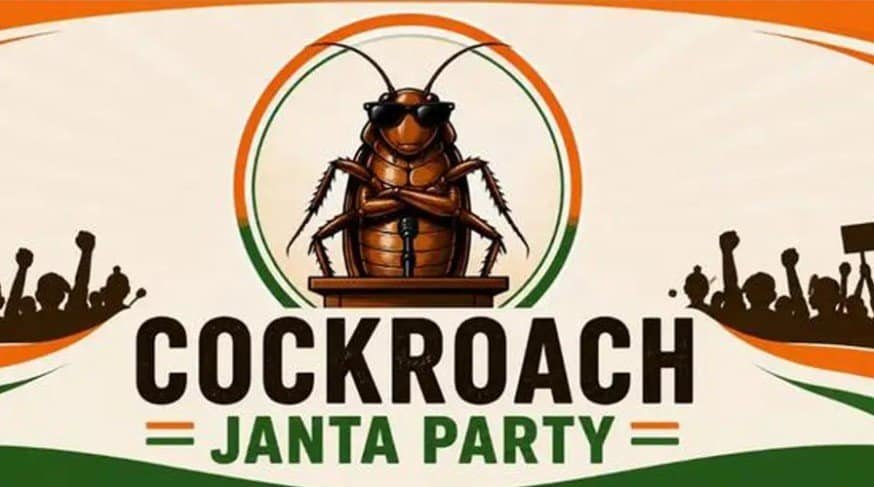
over a series of examination paper leaks, including allegations tied to medical entrance exams. As of the time of writing, Prime Minister Modi has not publicly confirmed acceptance of the resignation, and the political and administrative process around it is still unfolding.
This article lays out what is confirmed, what led up to the resignation, how different political actors have responded, and what questions remain open. Because this is a fast-moving, developing story, some details, particularly around the government’s final decision and any reshuffle of the Education Ministry, may change after publication.
Readers should treat time-sensitive specifics as accurate as of July 25, 2026, and verify the latest developments through current news sources before relying on them for decisions.
Quick Facts
- Who resigned? Dharmendra Pradhan, Union Education Minister
- Why? Weeks of youth-led protests over NEET-UG and other examination paper leaks
- Has PM Modi accepted the resignation? Not publicly confirmed as of the most recent reporting
- Who leads the protest movement? A youth campaign identifying itself as the Cockroach Janta Party (CJP)
- Named successor? None announced
- Story status: Developing; verify latest updates before relying on any time-sensitive detail
What Exactly Happened on July 25, 2026
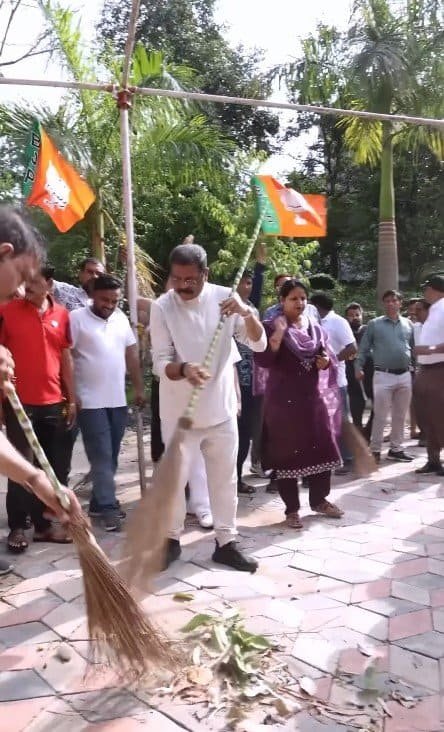
Dharmendra Pradhan, who has served as India’s Union Education Minister since July 2021 and was re-appointed to the role for a third time in June 2024, announced on the social media platform X that he had sent his resignation letter to Prime Minister Narendra Modi. ((The Guardian))
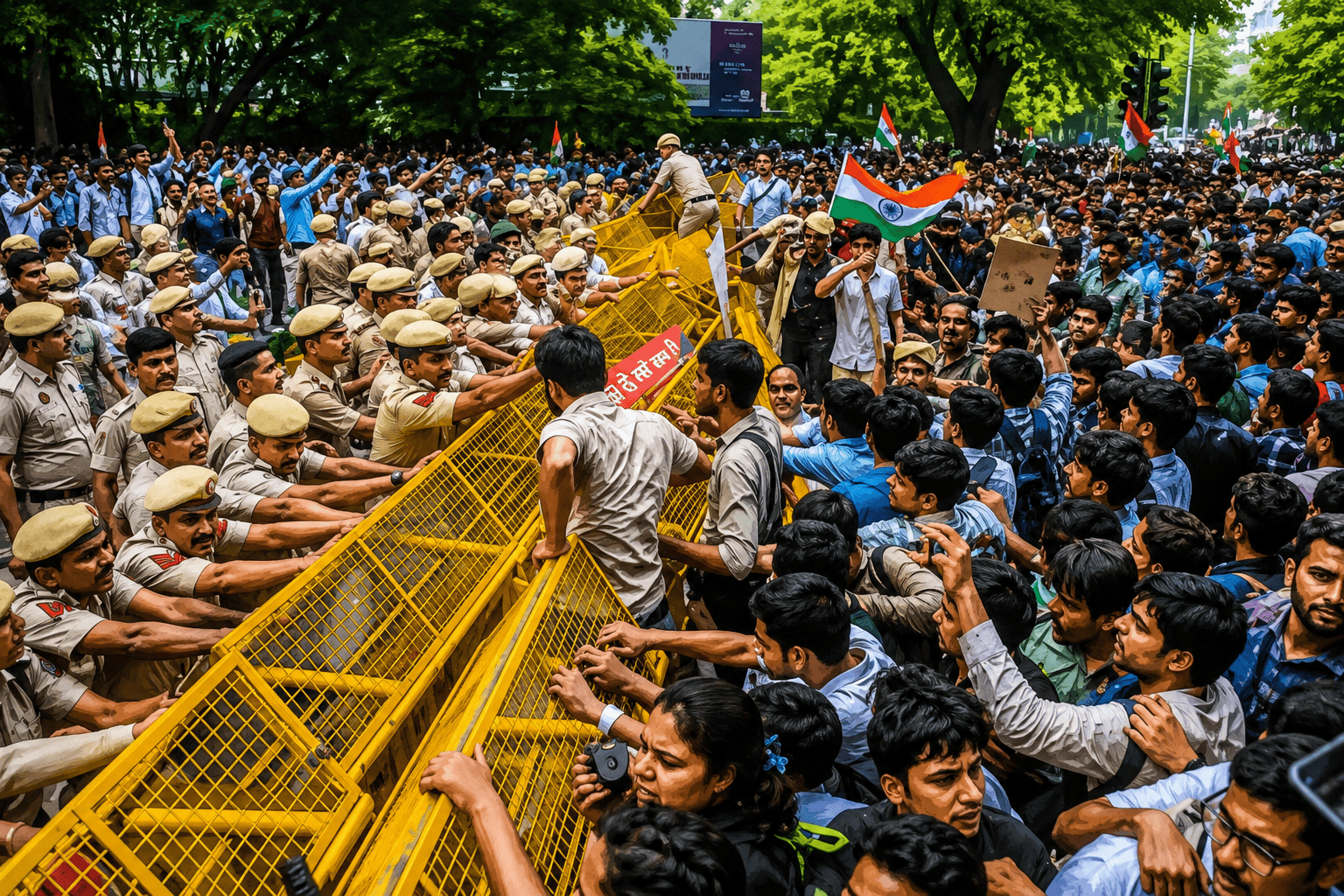
The announcement came on a Saturday, at a moment when police were using tear gas to disperse protesters near Jantar Mantar in New Delhi, one of the focal points of weeks of youth-led demonstrations.
In his message, Pradhan framed the decision as a response to the scale of public sentiment rather than a straightforward admission of personal wrongdoing. He indicated that he did not want the situation to be exploited by what he described as “anti-national forces,” and that he wanted students to be able to focus on their studies and careers rather than get pulled into legal and political entanglements. He also said he respected the aspirations and legitimate concerns being voiced by the country’s youth.
It is important to be precise about the procedural status of this resignation. In India’s parliamentary system, a minister’s resignation becomes formally effective only when the Prime Minister recommends its acceptance, and the President of India formally approves it.
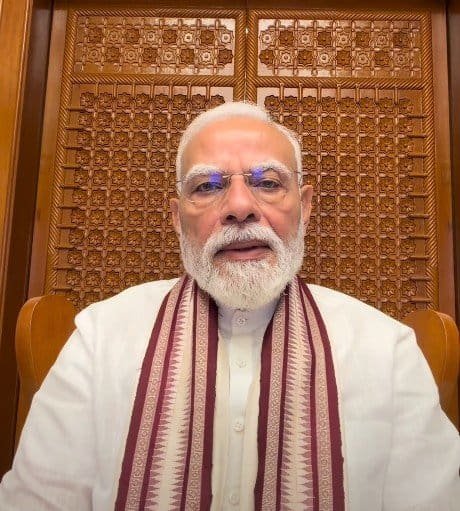
Multiple reports on July 25 noted that Modi had not yet publicly accepted the resignation at the time it was announced. This distinction matters: submitting a resignation letter is a political statement of intent, while acceptance is the administrative act that actually removes a minister from office. Readers should not assume the transition is complete simply because a resignation letter was sent. ((Deccan Herald))
The Background: How the Crisis Built Up
To understand why an education minister, a position not traditionally associated with mass unrest in India, became the target of sustained nationwide protests, it helps to trace the sequence of events over the preceding two years.
The NEET-UG 2024 Paper Leak Controversy
The roots of this crisis trace back to the National Eligibility cum Entrance Test for Undergraduate courses (NEET-UG), the exam that governs admission to medical colleges across India. According to figures reported around the 2024 exam cycle, the NTA-conducted test drew roughly 24 lakh (2.4 million) candidates.
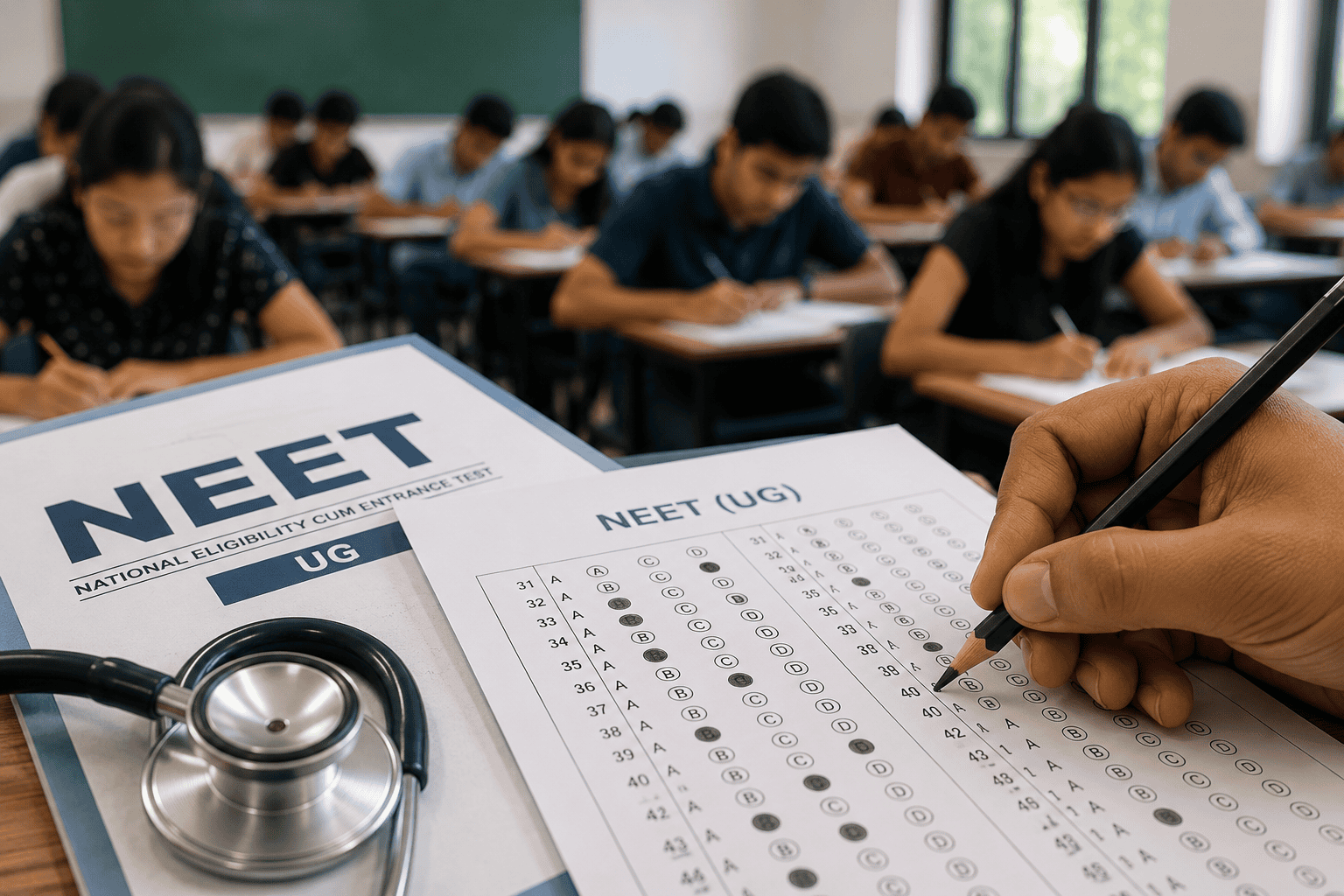
Shortly after results were announced in June 2024, allegations surfaced of question paper leaks, irregularities in grading, and organized cheating rings operating in specific exam centers, notably in Hazaribag and Patna in Bihar. Police investigations led to detentions in Jharkhand’s Deoghar district in connection with the alleged leak. ((The PIE News))
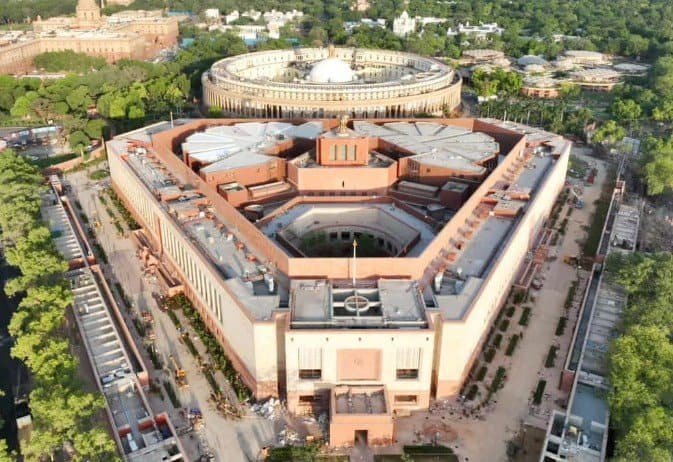
At the time, Pradhan’s public position, stated in Parliament, was that the irregularities were confined to a single center near Patna and did not represent a systemic failure. According to his own statement to the Lok Sabha, the NTA had conducted 240 examinations for more than 4.5 crore (45 million) students without a comparable prior breach, a figure that reflects the minister’s characterization of the agency’s record rather than an independently audited statistic.
Opposition leaders disputed this characterization sharply. Congress leader and Leader of the Opposition in the Lok Sabha, Rahul Gandhi, argued in Parliament that the problem was not isolated but symptomatic of deeper dysfunction in India’s examination architecture, and he was among the first prominent voices to call for Pradhan’s resignation.
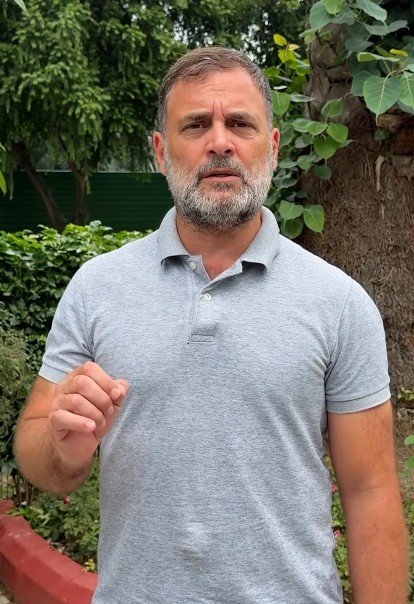
Other opposition parties, including the Aam Aadmi Party and various state Congress units, joined the call over the following weeks, with symbolic protests such as the burning of effigies in Ranchi and organized marches in Bhubaneswar. ((The Economic Times))
From a Political Controversy to a Youth Movement
For roughly two years, the NEET paper leak issue remained largely within the domain of conventional opposition politics: parliamentary debate, press statements, state-level protests organized by political parties. What changed by mid-2026 was the emergence of a decentralized, youth-driven protest movement that operated largely outside traditional party structures.
This movement adopted the name Cockroach Janta Party (CJP). Despite the name, reporting indicates it functions as a protest campaign and social-media-organized youth movement rather than a formally registered political party in the legal sense, a distinction worth stating clearly, since the name alone could otherwise mislead readers about what kind of entity is involved.
Reports suggest the name was intended as a defiant, almost mocking response to being dismissed or belittled by authorities, reclaiming a term of insult as a badge of persistence. The CJP built momentum through social media, organizing demonstrations in multiple cities and establishing a sustained protest presence at Jantar Mantar in New Delhi, a traditional site for public demonstrations near Parliament.
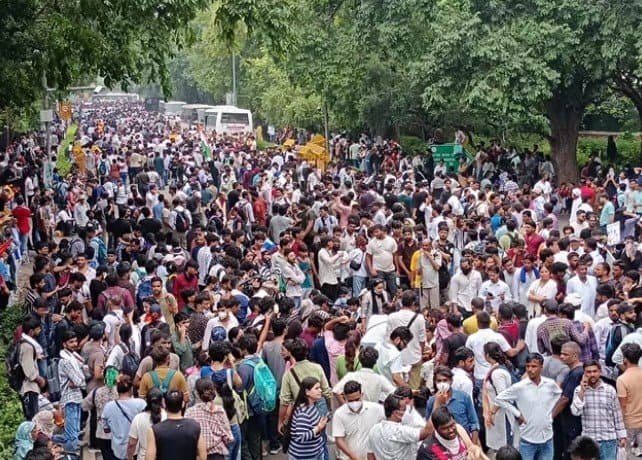
Public statements from CJP organizers consistently identified Pradhan’s resignation as the movement’s primary and most emphasized demand. Beyond that, organizers raised additional demands, including compensation for the families of students whose deaths were linked by reports to distress surrounding the paper-leak controversy. An end to what they characterized as excessive police action against protesters, and broader structural reforms to how national entrance exams are conducted and secured.
Escalation and Confrontation
In the weeks immediately preceding the resignation, the standoff intensified. Protests spread beyond Delhi to other cities, with several reports describing tens of thousands of participants at peak moments. Clashes between demonstrators and police were reported during the final week, with police tactics, including the use of tear gas, drawing criticism and, by several accounts, further energizing rather than dampening the movement.
The government initially resisted the core demand. According to reports published on July 24 to 25, senior BJP figures, including party president JP Nadda and minister Jitendra Singh, held extended talks with CJP representatives.
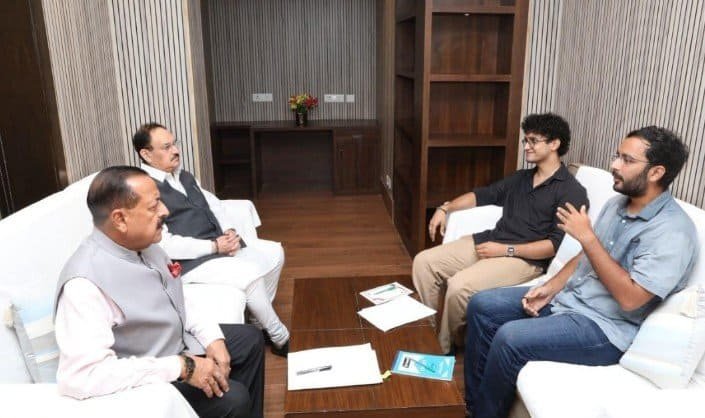
Following one such meeting, government sources cited in that reporting indicated that Pradhan was not expected to resign, even as the administration signaled openness to some of the movement’s secondary demands, reportedly including financial assistance for the families of students whose deaths were linked to the controversy and a review of policing tactics at protest sites.
Per the same reports, the government asked CJP leaders for roughly 24 hours to formulate a final response on the core demand for Pradhan’s removal.
That timeline ran out on Saturday, July 25, the same day Pradhan announced his resignation, just hours before a second round of talks between CJP leaders and federal ministers had been scheduled to take place. Whether that second round of talks proceeded, and in what form, was still unclear as events unfolded.
Reactions Across the Political and Public Landscape
The Protest Movement’s Response
CJP organizers described the resignation as a significant, hard-won victory. Public statements from the group framed it in terms of a broader democratic win, not simply a personnel change, reflecting the movement’s positioning of itself as a defense of institutional accountability rather than a narrowly partisan campaign against one minister.
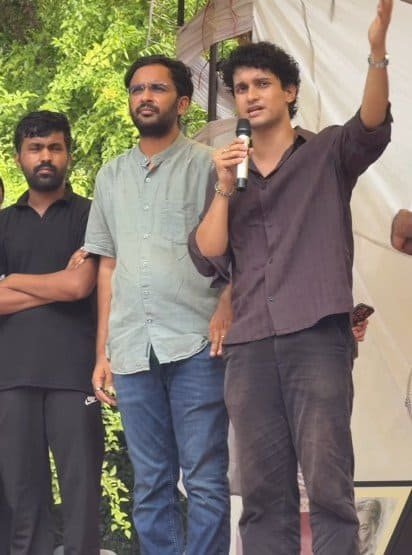
At the same time, the resignation of the minister was only one of several demands. It remains an open question whether the government will move further on the CJP’s other asks: legal protection for protesters who may otherwise face charges related to the demonstrations, and compensation packages for affected families. Movement leaders had signaled these would remain live issues regardless of the outcome on Pradhan’s position.
The Opposition’s Position
Opposition voices, led by figures such as Rahul Gandhi, had for months framed Pradhan’s removal as necessary but not sufficient. Gandhi had specifically argued that a lateral transfer of Pradhan to a different ministry, rather than a genuine removal from the Council of Ministers, would not satisfy the underlying demand for accountability.
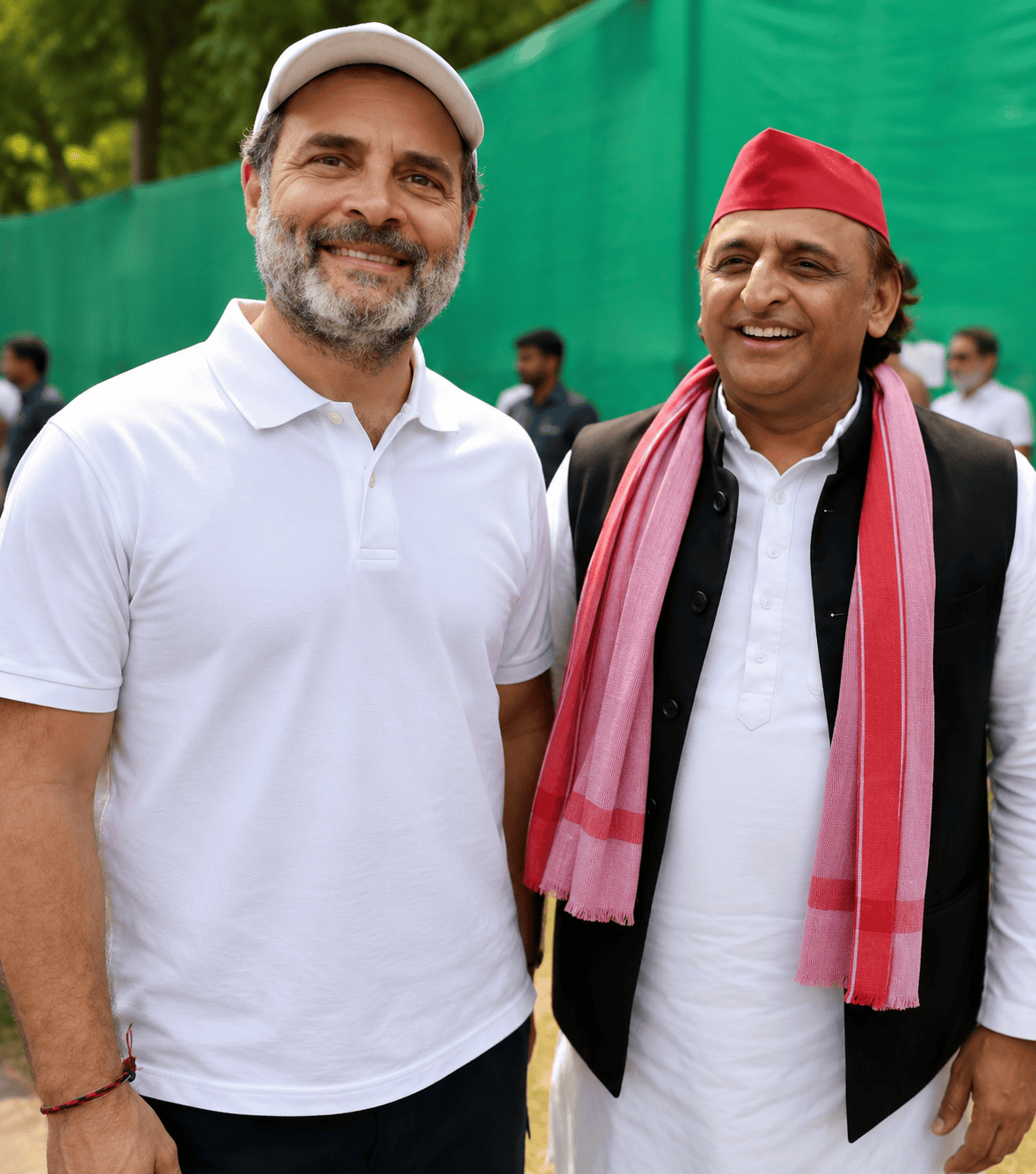
This distinction matters for how the story develops: a resignation from one portfolio does not necessarily mean an exit from government altogether, and opposition parties are likely to continue pressing on this point until the final disposition is clear.
The Government’s Position
Government messaging in the days before the resignation emphasized willingness to engage with protester demands on compensation and policing conduct while initially holding firm on the demand for Pradhan’s removal.
Several outlets characterized the eventual resignation submission as one of the most significant concessions the Modi government has made to this specific protest movement so far, though this framing reflects media interpretation rather than an explicit government statement to that effect.
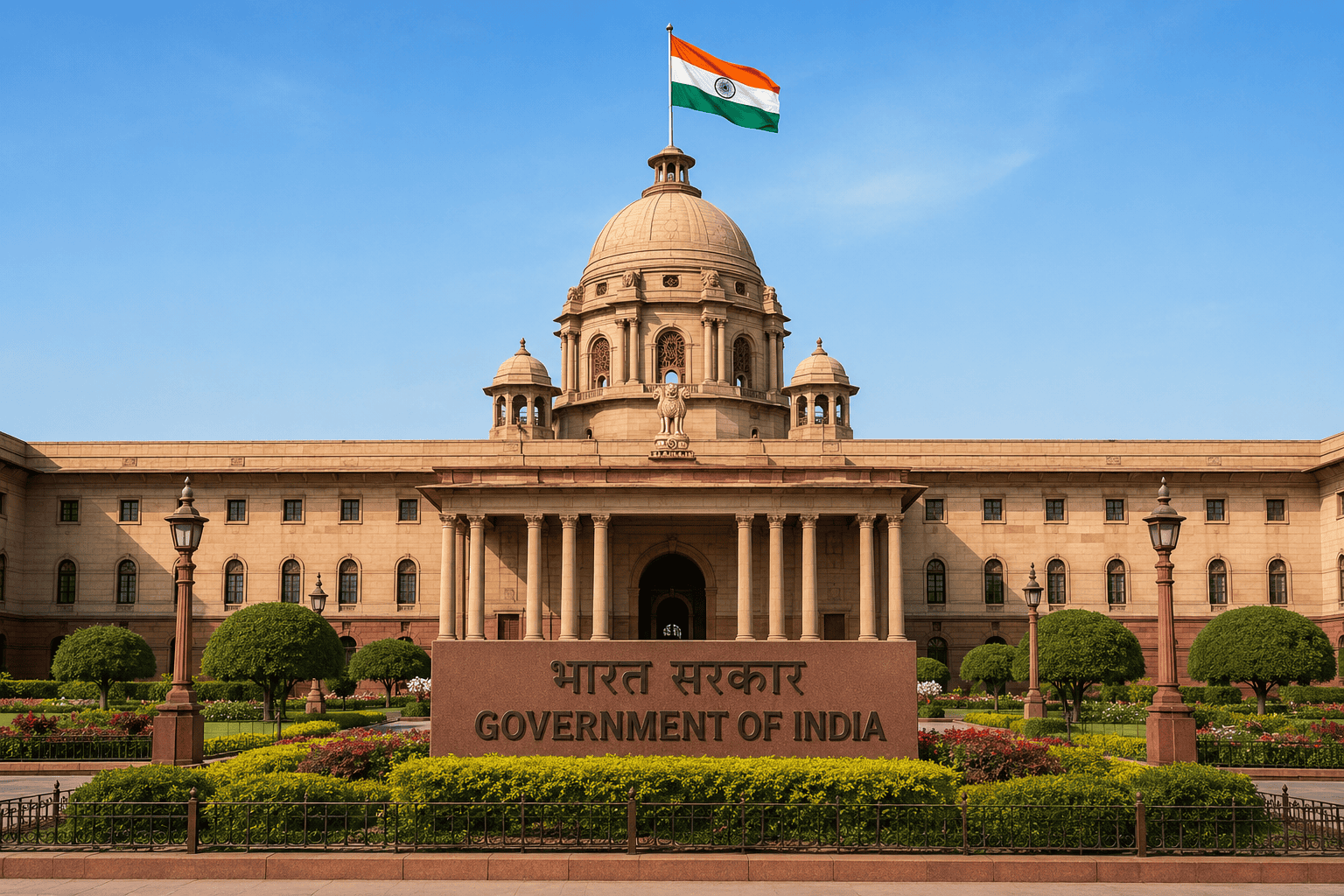
How the government frames this shift publicly, as a personal decision by Pradhan versus a response compelled by public pressure, will likely shape the political narrative in the days ahead.
Official Government Response: What Has and Hasn’t Been Confirmed
For a story like this, it is worth separating what official channels have actually said from what is being reported through sources or inferred from events. As of the most recent available reporting:
- Prime Minister’s Office (PMO): As of the latest publicly available reporting, the PMO had not issued a separate statement confirming formal acceptance of Dharmendra Pradhan’s resignation.
- Dharmendra Pradhan: Confirmed the resignation directly, in his own post on X, addressed to the Prime Minister.
- Ministry of Education: No separate ministry statement on transition arrangements or an interim charge had been reported.
- BJP leadership: Senior party figures were reported to have engaged directly in talks with CJP representatives in the days before the resignation, though this is sourced to media reporting on those meetings rather than an official BJP release.
- National Testing Agency (NTA): No new statement specifically tied to the resignation had been reported at this stage.
This gap between “confirmed by direct statement” and “reported by sources” is normal in fast-moving political stories, but it is worth keeping distinct: readers should treat anything not directly confirmed by an official statement as provisional until it is.
Understanding Dharmendra Pradhan’s Political Career and Its Relevance Here
Context on Pradhan’s own political background adds a layer of irony that has been widely noted in Indian media coverage. Long before becoming a Union minister, Pradhan was active in student politics through the Akhil Bharatiya Vidyarthi Parishad (ABVP), the student wing aligned with the BJP’s ideological family.
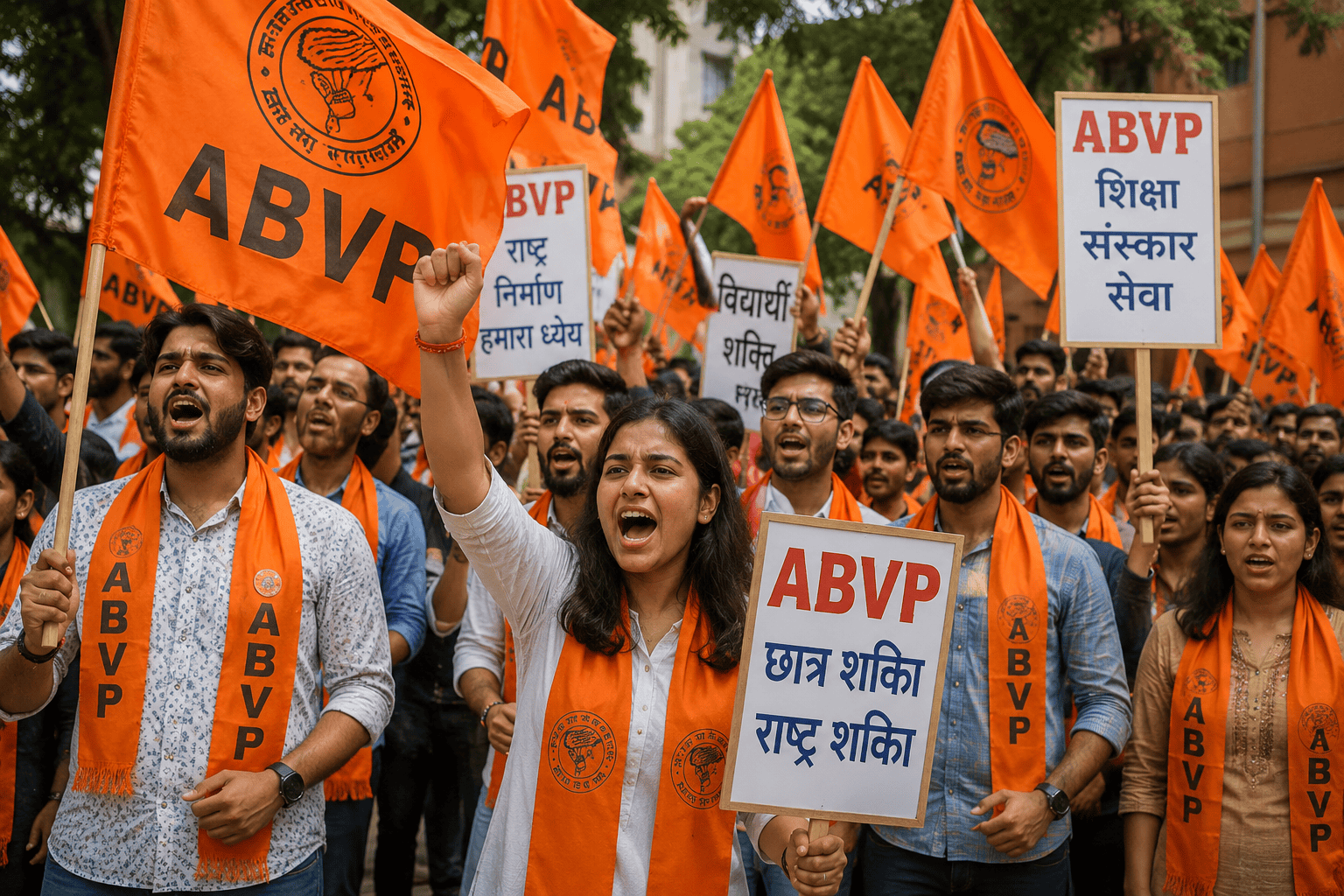
Reports have resurfaced claims that in 1997, as a student leader in Odisha, Pradhan himself participated in, and by some accounts led, protests against an alleged examination paper leak, reportedly facing police action during that agitation.
Whether or not the specifics of that decades-old episode are fully verified, the resurfacing of this history illustrates a recurring theme in Indian public life. Examination integrity has long been a flashpoint issue capable of mobilizing students, cutting across the usual left-right political divide, because it touches directly on questions of fairness, merit, and future livelihoods for a very large population of young test-takers.
Pradhan’s broader ministerial career has been extensive. Before taking charge of education in 2021, he held the Petroleum and Natural Gas portfolio from 2014 to 2021, during which he became closely associated with the Ujjwala Yojana, a scheme providing subsidized cooking gas connections to low-income households, work that earned him the informal nickname “the Ujjwala man” in some media coverage.

He also held the Steel portfolio and the Skill Development and Entrepreneurship portfolio at various points, and has represented Sambalpur in Odisha in the Lok Sabha since 2024, after earlier stints in the Rajya Sabha representing Bihar and Madhya Pradesh.
This background is relevant to assessing what comes next, though any specific outcome remains unconfirmed at this stage. Based on his previous senior ministerial roles, political observers may consider a return to a different ministry, a larger role within the party organization, or continuing as a backbench MP among the plausible paths, but no decision on Pradhan’s next role had been announced as of this writing, and readers should treat any such scenario as analysis rather than a forecast.
Why an Exam Leak Became a National Political Crisis
It is worth pausing on a question that observers outside India sometimes ask: how does an examination administration issue escalate into a movement capable of forcing a Union Cabinet minister’s resignation? The answer lies in the specific economic and social weight that competitive entrance exams carry in the Indian education system.
The stakes are generational, not incidental. For millions of Indian families, a single exam score determines access to medical, engineering, and other professional colleges, and by extension, lifetime earning potential, social mobility, and family status. Preparation for exams like NEET-UG frequently involves years of coaching, often at high financial cost to families with modest incomes, sometimes requiring relocation to coaching hubs.
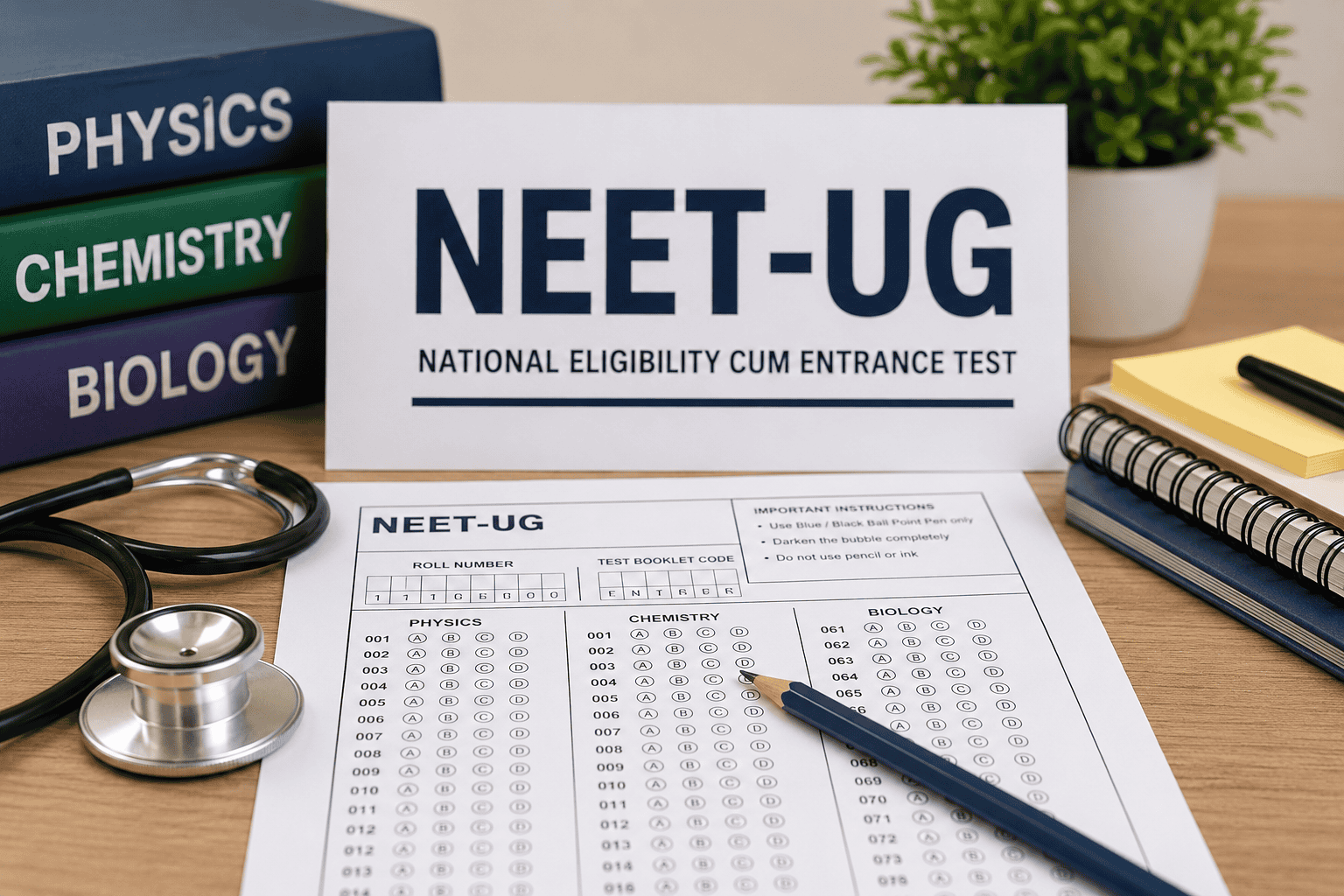
When a paper leak calls the integrity of that single high-stakes assessment into question, it does not just create an administrative headache; it threatens to devalue years of investment for every honest test-taker, regardless of whether they personally benefited or lost out.
A proposition worth stating plainly: a compromised exam does not just harm the students who cheated or the students who lost a seat to a cheater; it damages trust for every student who took the test honestly. That distinction is often lost in political discourse that focuses narrowly on “who leaked the paper,” when the more consequential question for public trust is “can any student who takes this exam believe the result reflects their own work?”
This is why paper-leak scandals in India tend to generate protest movements out of proportion to the number of students directly and provably affected: the injury is reputational and systemic, not just individual.
Failure economics applies here as much as they do in other high-stakes systems. Every retest, investigation, and legal proceeding carries a real cost: financial for the exam-conducting body, emotional and logistical for students who must prepare again, and reputational for the institutions involved.
A useful question for evaluating any exam-security proposal going forward is not simply “does this reduce the chance of a leak,” but “what does a single leak actually cost, across all these dimensions, compared to the cost of the security measure being proposed.”
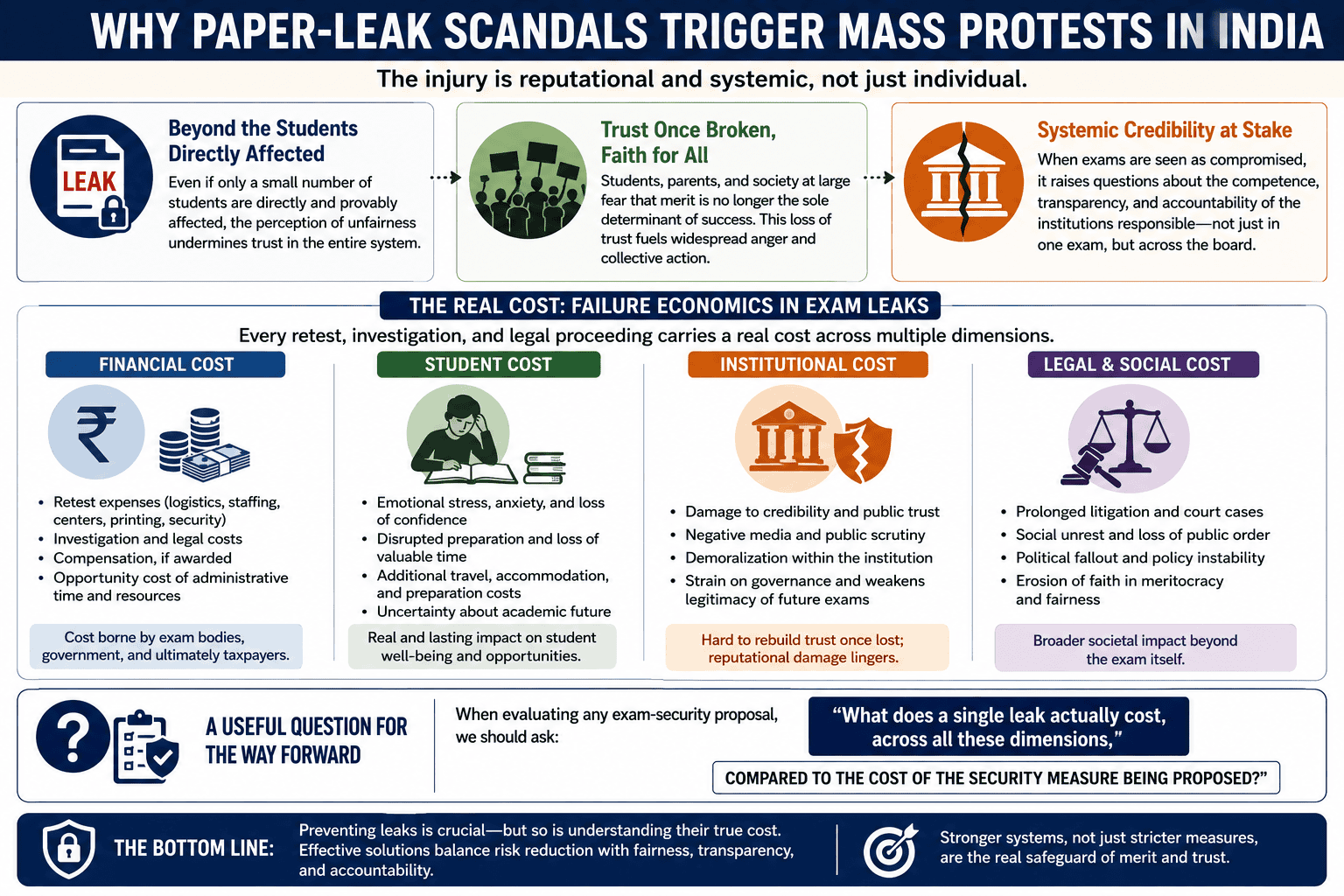
That framing, comparing prevention cost against realistic failure cost, tends to produce better policy than either extreme of “spend unlimited money on security” or “leaks are rare, so don’t over-invest.”
The reported student deaths changed the moral register of the debate. Reports linked several student deaths to distress surrounding the NEET-UG controversy, which shifted the protest movement from a dispute about administrative competence into one framed explicitly around loss of life and questions of institutional responsibility.
This is a distinct and more serious category of concern than exam unfairness alone, and it is a significant reason the CJP’s demand for compensation to affected families carried as much moral weight in public discourse as the demand for Pradhan’s resignation itself.
It is worth noting that establishing a direct causal link between any individual death and the exam controversy is a matter for formal inquiry, not something this article can establish; the point here is about how the reports shaped public and political sentiment, not a claim of proven causation in any specific case.
What This Episode Reveals About Examination Governance in India
Independent of the specific political outcome, this episode has renewed scrutiny of how India secures and administers large-scale national examinations. A few structural points are worth setting out clearly, without overstating what is or is not fact.
Scale creates vulnerability. National examinations such as NEET-UG involve tens of millions of candidates and thousands of physical test centers, each representing a potential point of failure in paper security, invigilation, or data handling.
A single compromised center can generate national-level distrust even when the overwhelming majority of centers function without incident. This is a structural reality of exam administration at this scale, not a judgment on any specific individual’s culpability.
The distinction between an isolated breach and a systemic failure matters and is often contested. Government officials, including Pradhan, maintained that anomalies were confined to specific centers, while opposition figures and protest organizers characterized the pattern as evidence of deeper systemic weakness.
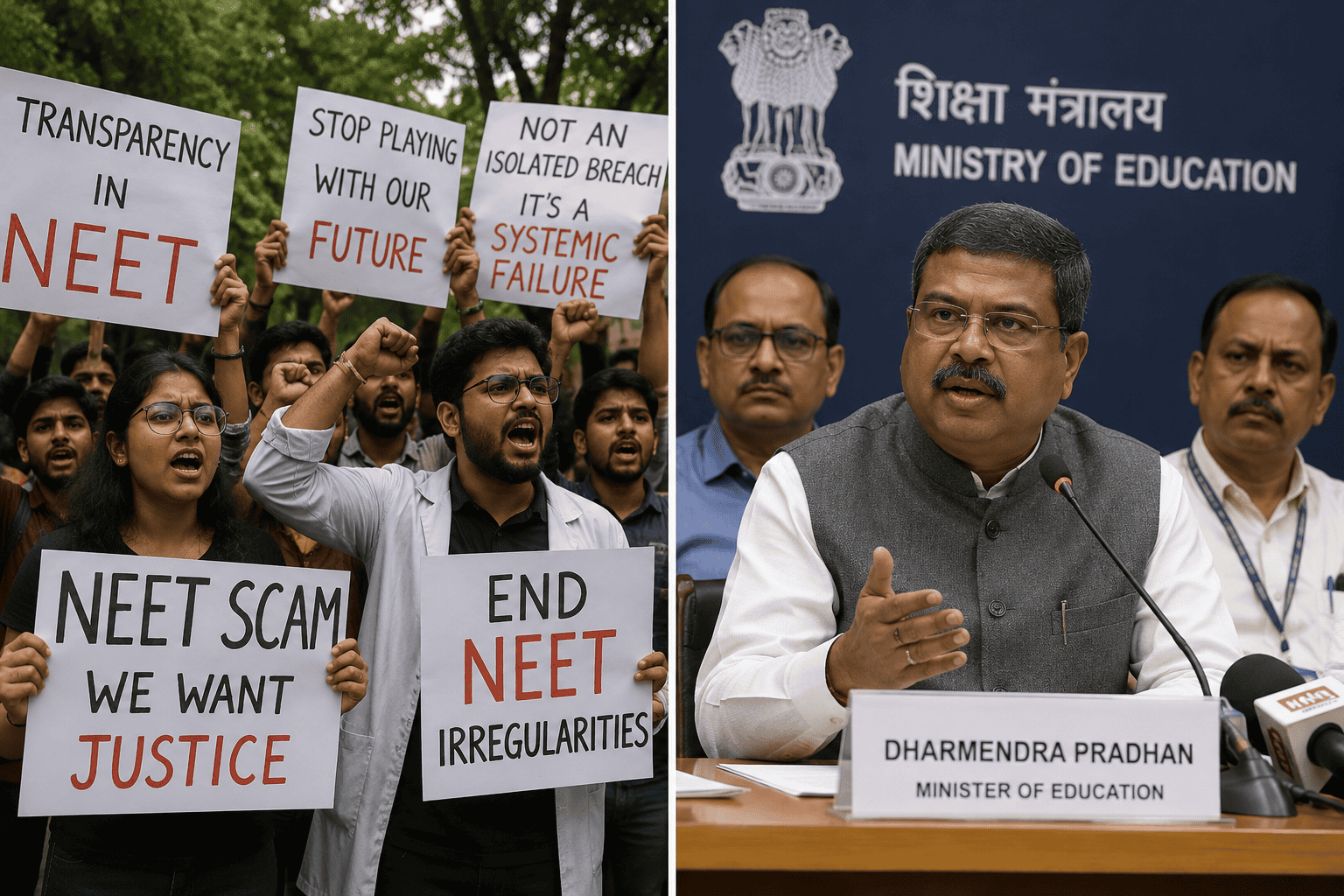
Both framings can be internally consistent while disagreeing on interpretation of the same underlying facts; resolving this requires transparent, independently verifiable investigation rather than assertion from either side.
Political accountability and technical fixes are separate tracks. A minister’s resignation addresses a political accountability demand. It does not, by itself, change the technical security architecture of how question papers are printed, transported, stored, and distributed, nor does it change how candidate identity is verified at test centers.
Whether structural reforms to exam security follow this resignation, such as end-to-end digital tracking of question papers, biometric verification protocols, or restructured vendor oversight, is a separate matter that will need to be evaluated on its own evidence over the coming months.
Compensation and legal protection for affected families and protesters are distinct policy questions from ministerial accountability. The CJP’s demands included compensation for families of students whose deaths were linked by reports to distress surrounding the paper-leak fallout, and protection from prosecution for protesters.
These are matters of executive policy and, in some cases, judicial process, and their resolution will depend on decisions taken independently of whether Pradhan’s resignation is formally accepted.
Political Implications for the Modi Government
Beyond the immediate question of who runs the Education Ministry, this resignation carries broader political significance that is worth unpacking on its own terms.
A precedent for decentralized protest movements. For over a decade, large-scale sustained pressure on the Modi government has more often come from organized, identifiable actors, opposition parties, farmer unions, specific professional bodies- than from loosely organized, digitally coordinated youth movements without a clear central leadership structure.
If the CJP’s campaign is understood by the public as having directly produced a Cabinet-level resignation, it may function as a template that other issue-specific youth movements look to replicate on unrelated grievances.
Whether that proves true will depend heavily on how the government handles the aftermath: a swift, generous response to the CJP’s remaining demands would reinforce the template’s effectiveness, while a slow or minimal follow-through could just as easily discourage future movements from expecting similar results.
Distinguishing a personnel change from a policy change. Governments facing sustained protest pressure sometimes face a strategic choice between what might be called a personnel concession (removing an individual) and a policy concession (changing the underlying system that produced the grievance).
A personnel concession is often faster and lower-cost to deliver, but it does not by itself resolve the structural issue that produced the protest in the first place.
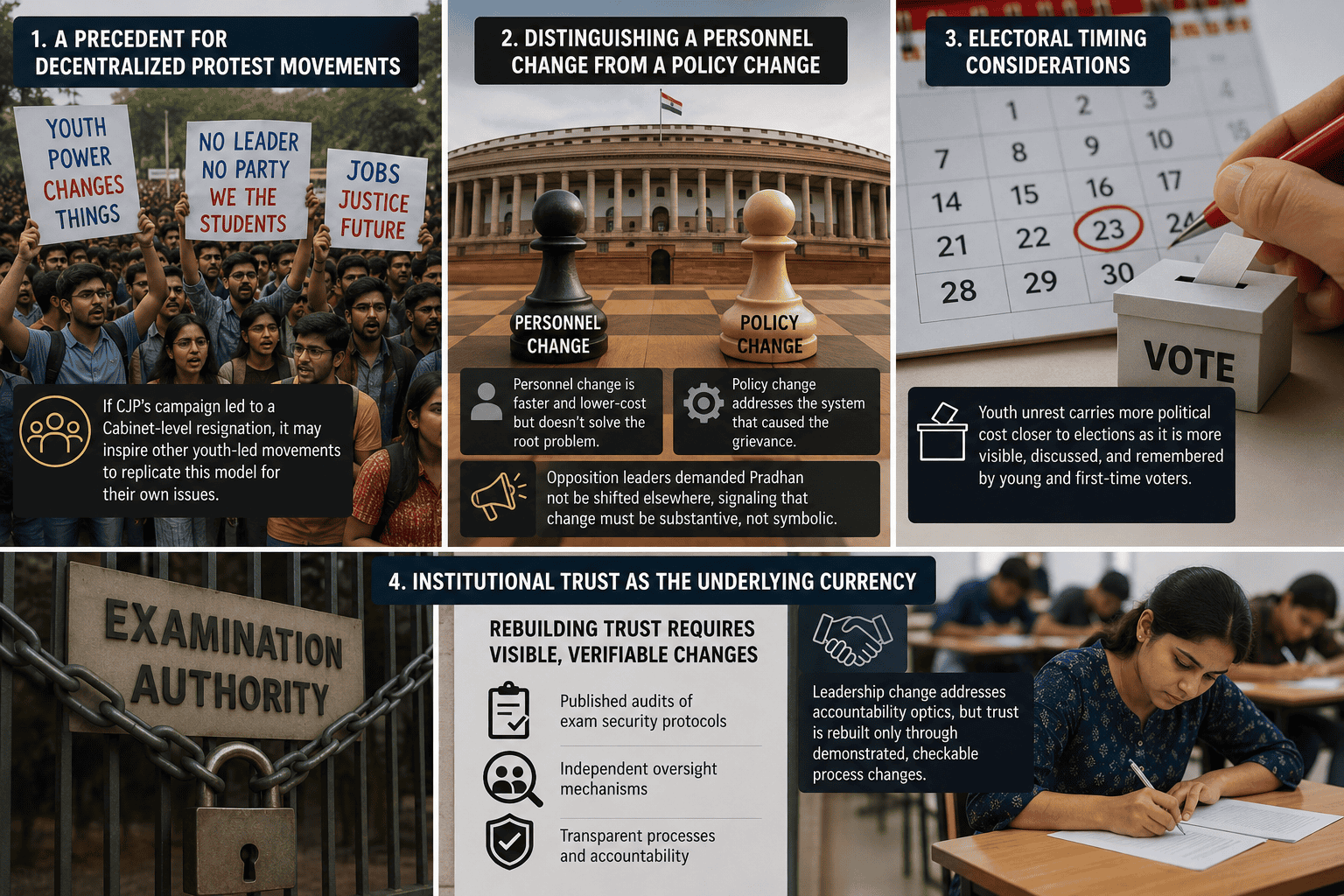
Opposition leaders’ explicit demand that Pradhan not simply be “shifted” to another portfolio reflects an awareness of this distinction: they were signaling that a personnel change alone, without accompanying structural reform to exam security, would be read as a symbolic rather than substantive response.
Electoral timing considerations. Any assessment of the political calculus behind the timing of this resignation should be treated cautiously; connecting a resignation decision to a specific electoral calendar is a claim that lacks evidence unless the government or credible reporting states it explicitly.
What can be said with more confidence is that sustained, visible youth unrest tends to carry more political cost the closer it sits to state or national elections, simply because it is more likely to be covered, discussed, and remembered by first-time and young voters, a demographic that has grown in overall electoral weight in recent Indian election cycles.
Institutional trust as the underlying currency. Whatever the eventual policy outcome, episodes like this one tend to have a lasting effect on public trust in examination bodies and, more broadly, in the administrative competence of the ministries overseeing them, independent of which individual holds a given portfolio at any given time.
Rebuilding that trust typically requires visible, verifiable process changes, such as published audits of exam security protocols or independent oversight mechanisms, rather than statements of reassurance alone.
This is a distinction any institution facing a credibility crisis of this kind should keep in view: a leadership change addresses accountability optics, but the underlying trust deficit is closed only by demonstrated, checkable changes to the process that failed.
Verified Timeline of Key Events
The dates below are compiled from multiple news reports referenced throughout this article. Where a detail is attributed to “reports” rather than an official statement, treat it as media-sourced rather than officially confirmed.
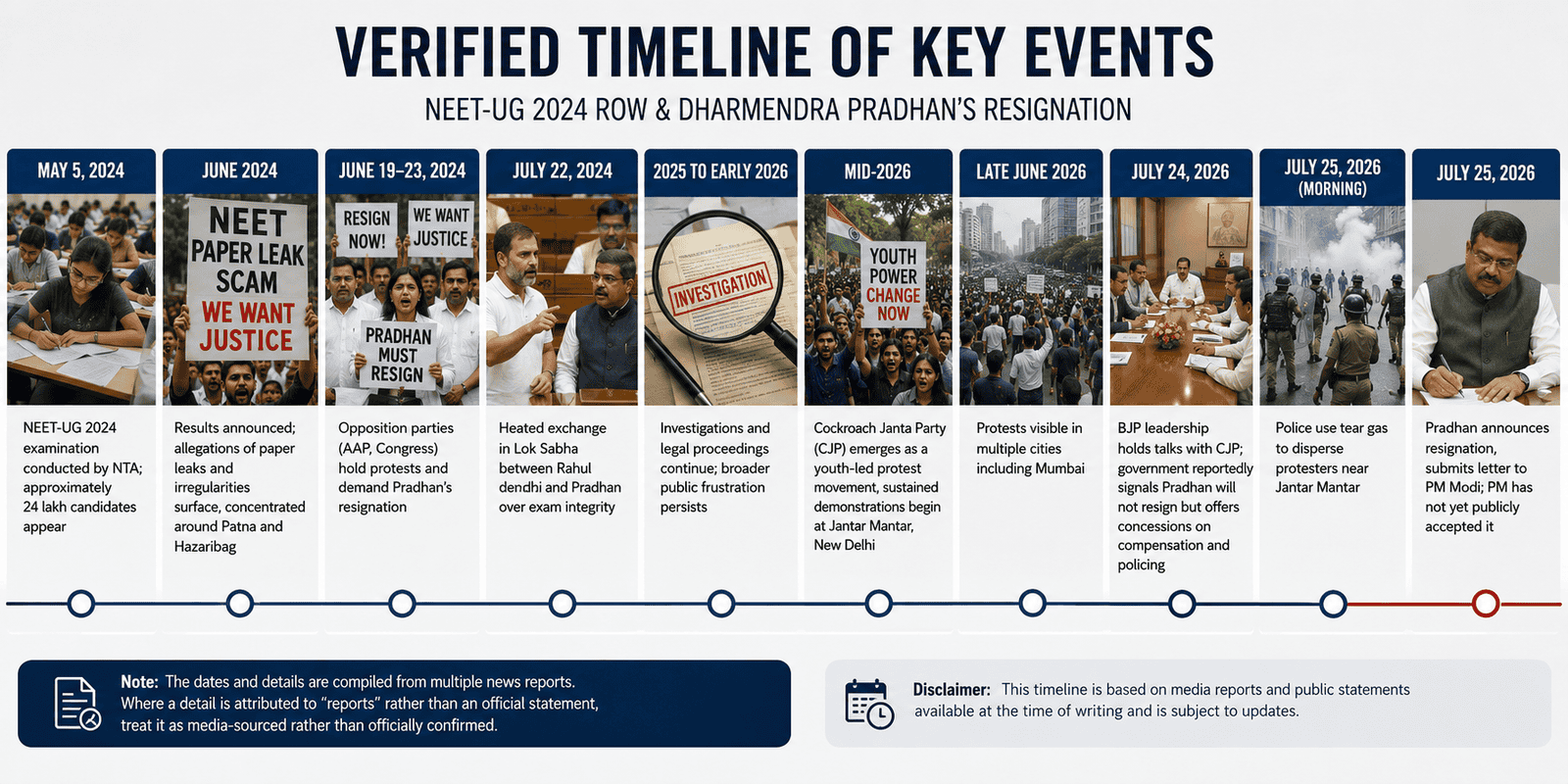
May 5, 2024: NEET-UG 2024 examination conducted by NTA; approximately 24 lakh candidates appear
June 2024: Results announced; allegations of paper leaks and irregularities surface, concentrated around Patna and Hazaribag
June 19 to 23, 2024: Opposition parties (AAP, Congress) hold protests and demand Pradhan’s resignation
July 22, 2024: Heated exchange in Lok Sabha between Rahul Gandhi and Pradhan over exam integrity
2025 to early 2026: Investigations and legal proceedings continue; broader public frustration persists
Mid-2026: Cockroach Janta Party (CJP) emerges as a youth-led protest movement, sustained demonstrations begin at Jantar Mantar, New Delhi
Late June 2026: Protests visible in multiple cities including Mumbai
July 24, 2026: BJP leadership holds talks with CJP; government reportedly signals Pradhan will not resign but offers concessions on compensation and policing
July 25, 2026 (morning): Police use tear gas to disperse protesters near Jantar Mantar
July 25, 2026: Pradhan announces resignation, submits letter to PM Modi; PM has not yet publicly accepted it
Frequently Asked Questions
Has Dharmendra Pradhan officially left the Education Ministry?
He has submitted his resignation to the Prime Minister, but as of the most recent reporting, the Prime Minister had not yet publicly confirmed acceptance. Under India’s system, a resignation typically takes formal effect only once accepted and processed through the President’s office. Readers should check the latest news for confirmation of the final status.
Why did students specifically target the Education Minister rather than the NTA or another body?
The Education Ministry has administrative oversight over the National Testing Agency, which conducts NEET-UG and other national exams. Protesters and opposition politicians argued that ultimate political accountability for repeated lapses rested with the minister overseeing the sector, even though the NTA operates as a distinct implementing body.
What is the Cockroach Janta Party?
It is a youth-led protest movement, not a registered conventional political party in the traditional sense as commonly understood, that organized sustained demonstrations against examination paper leaks and demanded Pradhan’s resignation, among other reforms. Its name is widely understood as a defiant reclaiming of an insult.
Will this affect future NEET or other national exam administration?
That depends on policy decisions made separately from the resignation itself. A change in minister does not automatically change exam security protocols; whether reforms follow will need to be tracked through subsequent government announcements.
Who might replace Pradhan as Education Minister, if the resignation is accepted?
As of this writing, no successor has been officially named. Any specific name circulating in speculation should be treated as unconfirmed until an official announcement is made.
Is this the first time an Indian Cabinet minister has resigned over exam-related protests?
Ministerial resignations in India have occurred for a range of reasons: health, legal cases, electoral defeats, and political realignments among them. A resignation driven directly by a sustained, non-party youth protest movement over examination integrity is unusual in scale and character, which is a significant part of why this episode has drawn wide domestic and international coverage.
It should not, however, be read as unprecedented in the sense of “the first ever exam-related resignation pressure”: Pradhan’s own predecessor, Ramesh Pokhriyal, resigned from the Education Ministry role in 2021 citing health reasons, in a reminder that ministerial exits from this specific portfolio have had varied causes over the years.
Does Pradhan’s resignation mean he is legally responsible for the paper leaks?
No. A ministerial resignation is a political and administrative act, not a legal finding. Any criminal investigation into the alleged NEET-UG paper leaks, including the cases reportedly under CBI investigation, proceeds through the judicial and law-enforcement system independently of a minister’s political status. Conflating the two would overstate what a resignation actually establishes.
What This Resignation Does Not Mean
Because a story like this tends to generate assumptions that outrun the facts, it’s worth stating plainly what this resignation does, and does not, establish:
– It does not establish legal guilt. Resigning a political office is not a court finding. Any question of individual or institutional legal responsibility for the alleged paper leaks is a matter for ongoing investigation and judicial process, not for this resignation to settle.
– It does not automatically reform the NTA or exam security architecture. A change in the minister who oversees the sector does not, by itself, alter how question papers are printed, transported, or secured, or how candidate identity is verified at test centers. Any such reform would require separate, explicit policy action.
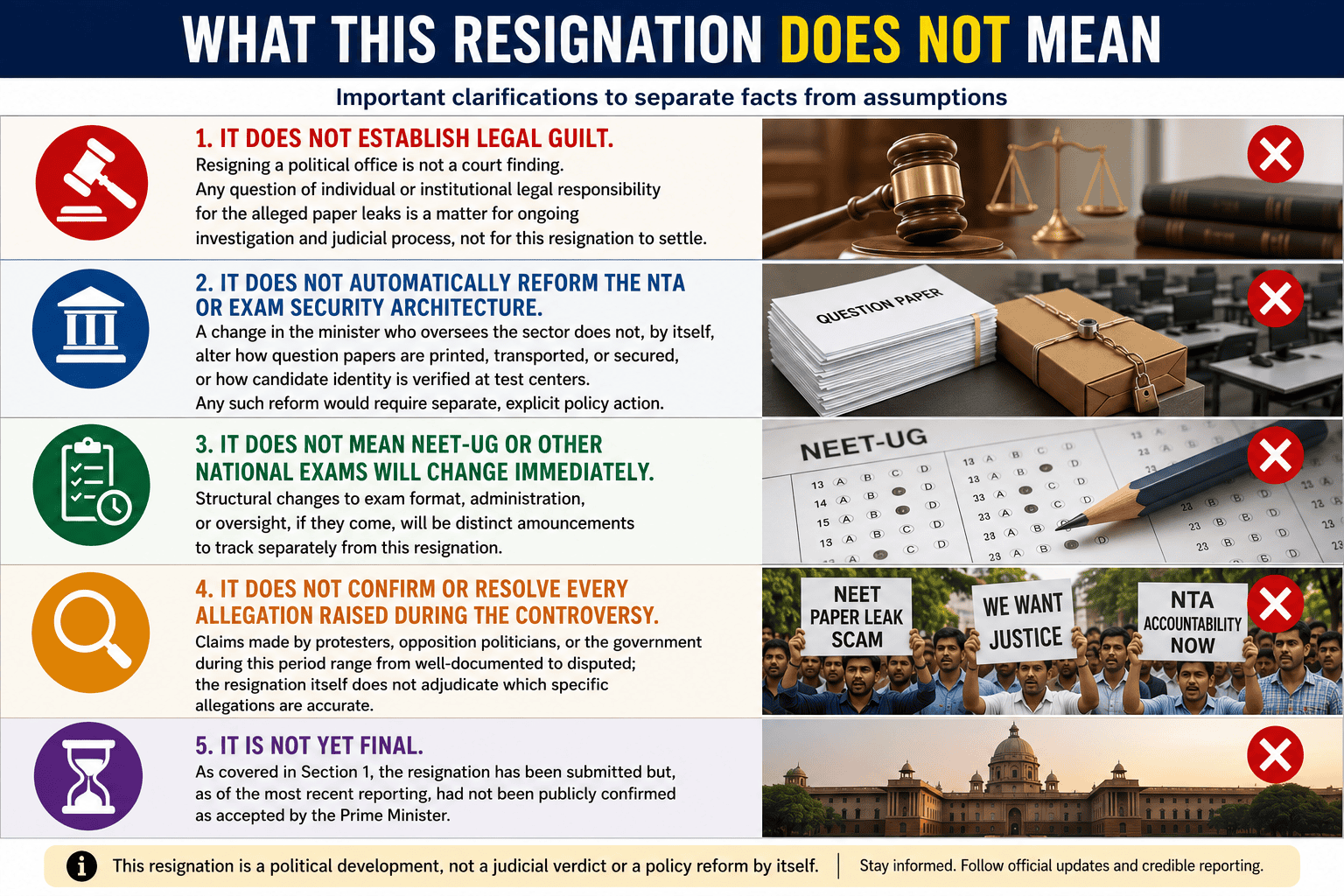
– It does not mean NEET-UG or other national exams will change immediately. Structural changes to exam format, administration, or oversight, if they come, will be distinct announcements to track separately from this resignation.
– It does not confirm or resolve every allegation raised during the controversy. Claims made by protesters, opposition politicians, or the government during this period range from well-documented to disputed; the resignation itself does not adjudicate which specific allegations are accurate.
– It is not yet final. As covered in Section 1, the resignation has been submitted but, as of the most recent reporting, had not been publicly confirmed as accepted by the Prime Minister.
What to Watch Next
Several open questions will determine how this story develops in the coming days and weeks:
1. Formal acceptance. Whether and when Prime Minister Modi formally accepts the resignation, and whether Pradhan is reassigned elsewhere in government or exits the Council of Ministers entirely.
2. CJP’s remaining demands. Whether the government moves on compensation for affected families and legal protection for protesters, independent of the ministerial question.
3. Structural reform announcements. Whether the government proposes concrete changes to exam security, NTA governance, or oversight mechanisms in response to the sustained pressure.
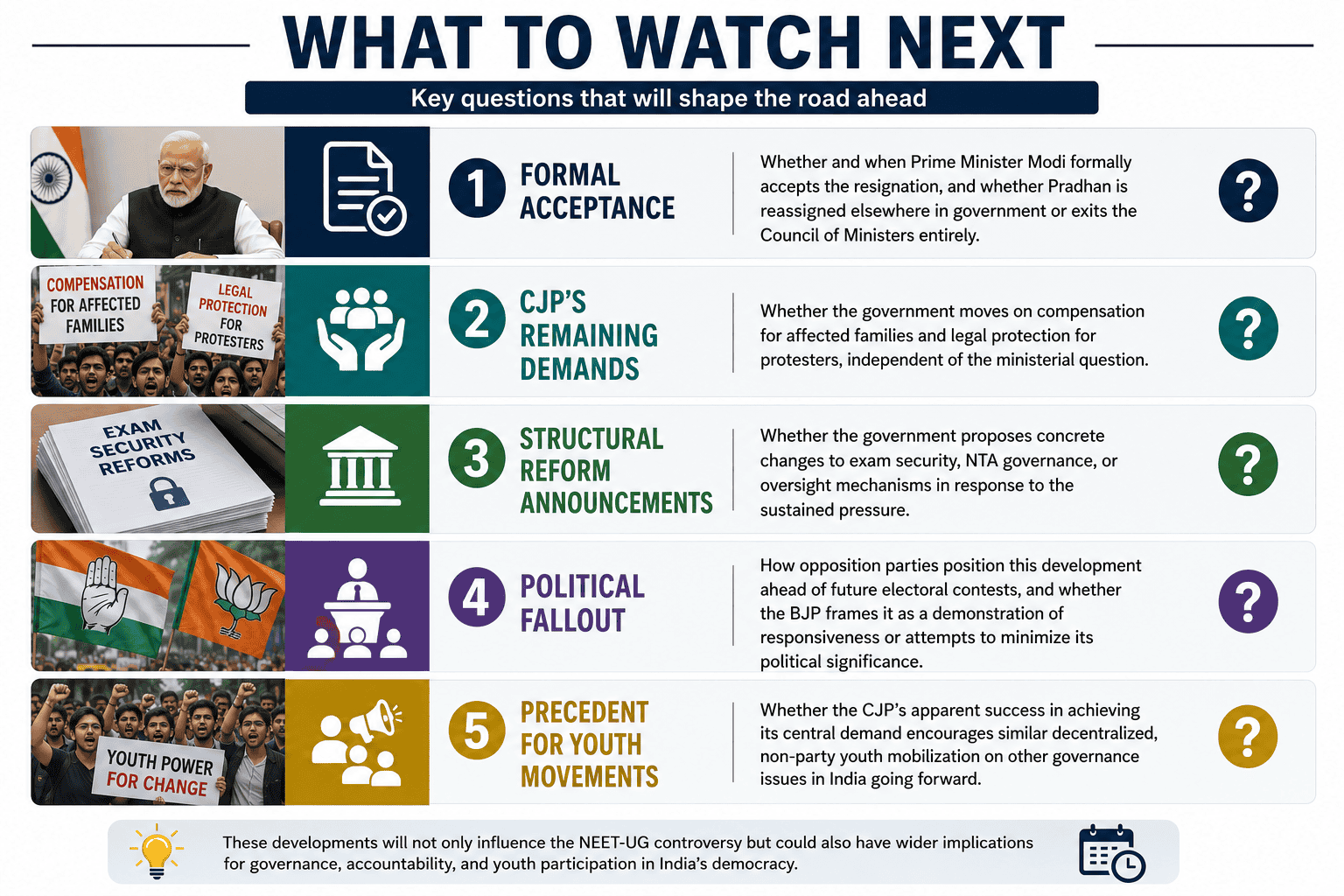
4. Political fallout. How opposition parties position this development ahead of future electoral contests, and whether the BJP frames it as a demonstration of responsiveness or attempts to minimize its political significance.
5. Precedent for youth movements. Whether the CJP’s apparent success in achieving its central demand encourages similar decentralized, non-party youth mobilization on other governance issues in India going forward.
A Note on Accuracy and Developing Coverage
This is an actively developing news story, and several elements, most notably whether the resignation is formally accepted and who, if anyone, succeeds Pradhan, were not settled as of the information available at the time this article was written. Readers relying on this piece for time-sensitive decisions, reporting, or further commentary should cross-check the latest developments against current, dated news sources before treating any unresolved point as final.
Commentary exchanges, including Pradhan’s and Rahul Gandhi’s statements
– Press Trust of India (PTI) and Reuters: for wire-verified, minute-by-minute developments
– The Hindu, Indian Express, Al Jazeera, and other established national/international newsrooms: for ongoing analysis and confirmation of contested details.
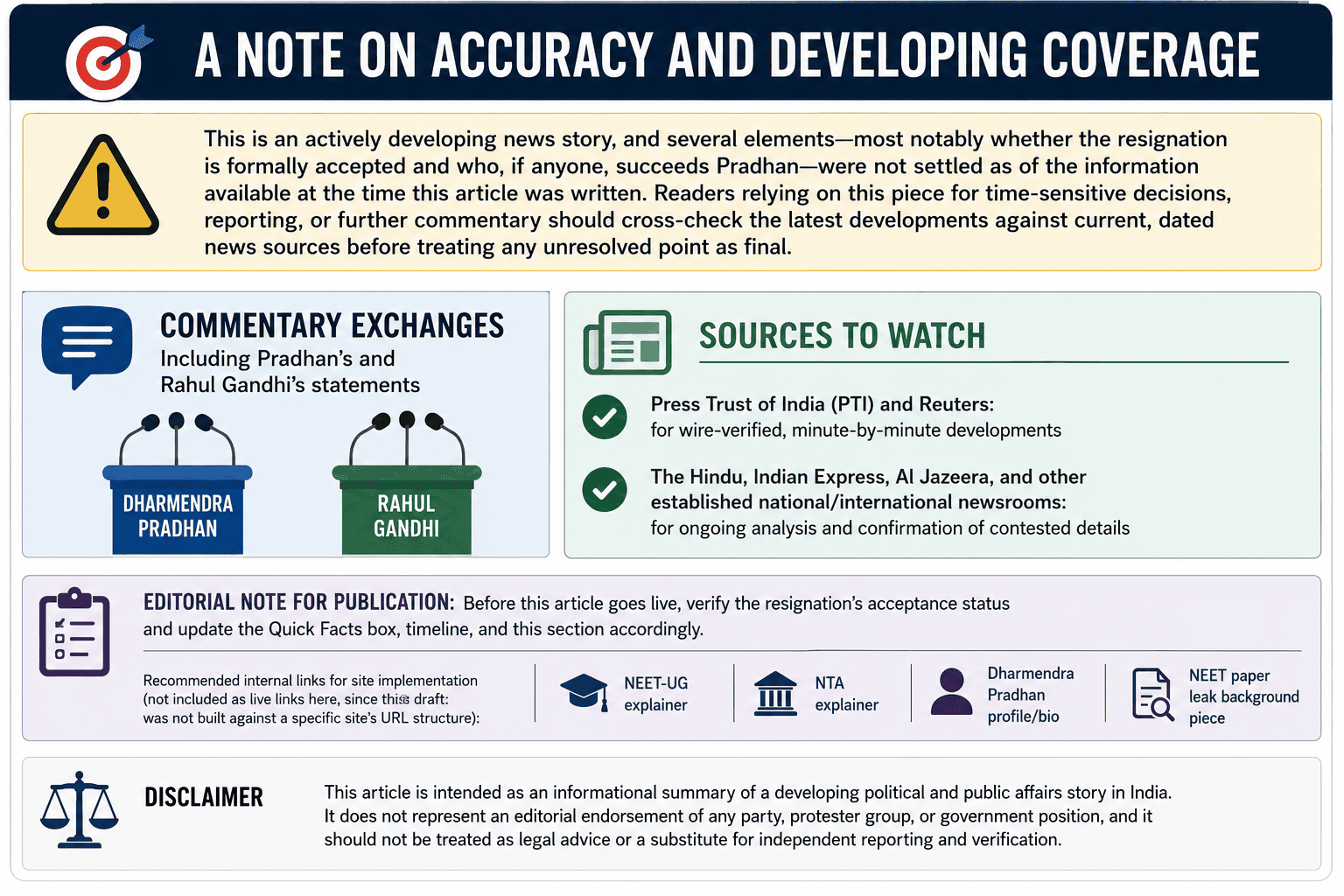
Editorial note for publication: before this article goes live, verify the resignation’s acceptance status and update the Quick Facts box, timeline, and this section accordingly. Recommended internal links for site implementation (not included as live links here, since this draft was not built against a specific site’s URL structure): a NEET-UG explainer, an NTA explainer, a Dharmendra Pradhan profile/bio page, and a dedicated NEET paper leak background piece, each linked contextually at first mention in Sections 1 to 2.
This article is intended as an informational summary of a developing political and public affairs story in India. It does not represent an editorial endorsement of any party, protester group, or government position, and it should not be treated as legal, political, or investment advice.

Late evening 25th of July, 2026, one news is breaking that the President of India (Dropadi Murmu) has accepted the resignation of Union Education Minister (Dharmendra Pradhan) on the advice of the Prime Minister of India (Narendra Modi). Additionally, (Pralhad Joshi) has been given additional charge of the education ministry (News on AIR). Also, media sources report that the Modi government will introduce the Anti-Paper Leak Bill in Parliament next week, most likely on Monday (27th of July, 2026) (News18).
The Bill Passes Both Houses
The Public Examination (Prevention of Unfair Means) Amendment Bill, 2026 has now cleared Parliament in its entirety. The Lok Sabha passed the bill on July 29, amid heavy uproar and sloganeering from opposition benches, with the bill cleared by voice vote before the House was adjourned. A day later, on July 30, the Rajya Sabha also passed the bill by voice vote, completing its journey through Parliament.
The legislation had been introduced days after nationwide student protests over the NEET controversy led to the resignation of Dharmendra Pradhan as education minister. Replying to the debate in the upper house, Union Minister Jitendra Singh said the amendments would further strengthen the legal framework for preventing unfair means in public examinations while safeguarding the interests of students and youth. He clarified that the law goes well beyond paper leaks alone – covering offences such as question paper leaks, tampering with computer resources or examination records, fake admit cards, fake websites, impersonation and other organised examination-related fraud.
The bill amends the Public Examinations (Prevention of Unfair Means) Act, 2024 by introducing faster investigations, special fast-track courts and stricter punishments. With the President’s assent on August 1, 2026, the amendment has officially become law and is now in force.
What’s New in the Amendment

The core philosophy hasn’t shifted — the law still targets organized leak networks rather than individual candidates. What’s changed is the severity and speed of punishment. The amended legislation prescribes stricter penalties, including up to 10 years in prison and a fine of up to Rs 50 lakh for individuals involved in paper leaks, organized crime networks now face a minimum fine of Rs 10 crore along with imprisonment ranging from seven to ten years.
Political Backdrop
The bill’s passage came against a charged political backdrop. Proceedings were repeatedly disrupted over Rahul Gandhi’s remarks against Amit Shah and allegations that the home minister ordered pellet-gun action against student protesters during a July 20 march from Jantar Mantar. The government had separately announced an exam reform task force headed by Infosys co-founder Nandan Nilekani on July 26, tasked with recommending broader reforms to the examination system.
Following the Rajya Sabha’s approval, Prime Minister Narendra Modi welcomed the passage of the legislation, saying it would strengthen the integrity of public examinations. Home Minister Amit Shah described it as an important milestone, while BJP president JP Nadda and Uttar Pradesh Chief Minister Yogi Adityanath said the amendments would help protect merit and improve transparency in the examination system
Old Law vs. New Amendment: What Changed?

| Point | Public Examinations Act, 2024 (Original) | 2026 Amendment Bill |
|---|---|---|
| Individual offence (use of unfair means) | 3 to 5 years imprisonment and a fine of up to Rs 10 lakh | 5 to 10 years imprisonment and a fine of up to Rs 50 lakh |
| Organized crime | 5 to 10 years imprisonment and a minimum fine of Rs 1 crore | 7 to 10 years imprisonment and a minimum fine of Rs 10 crore |
| Service providers (exam agencies, vendors) | Fine of up to Rs 1 crore, recovery of exam costs, and debarment for 4 years | Fine of up to Rs 5 crore, recovery of exam costs, and debarment extended to 8 years |
| Investigation and trial | Existing legal framework under the 2024 Act | Faster investigations, a Special Task Force, Special Fast-Track Courts, and tighter timelines - investigation within two months, trial within three |
| Scope | Covers UPSC, SSC, Railway Recruitment Boards, IBPS, and NTA exams | Scope remains the same, with stronger institutional accountability and enforcement |
| Reason for amendment | Introduced after the 2024 paper leak controversies, including NEET | Introduced after nationwide protests over the 2026 NEET controversy, followed by the formation of the Nandan Nilekani-led exam reform task force |
The amendment does not replace the 2024 law. Instead, it strengthens the existing Public Examinations (Prevention of Unfair Means) Act, 2024 with tougher penalties, time-bound investigations, Special Task Forces, Special Fast-Track Courts, stricter institutional accountability and faster appeals to crack down on organized paper leak networks and restore public trust in India’s examination system
Read more articles like this raghav-chadha