
Hollywood AI War in 2026: Sora Collapse, Deepfakes & the Creator Crisis

Hollywood AI War is getting messier by the day, as billion-dollar partnerships collapse, AI-generated deepfakes spread across social media, and studios scramble to protect the future of entertainment.
For years, Hollywood treated artificial intelligence as a distant threat, something to negotiate around in contracts, debate at awards shows, and protest on picket lines. That era is over.
In 2026, the AI invasion of the entertainment industry has turned from a slow creep into an all-out collision, and the consequences are playing out in real time. A billion-dollar deal imploding, a Chinese AI tool generating viral deepfakes of A-list stars, and the most powerful creative unions in America scrambling to stay relevant.
This is not a trend piece about what might happen. Everything discussed below has already happened.
The Sora Disaster: How a $1 Billion Deal Died in 30 Minutes
In December 2025, Disney CEO Bob Iger announced what was meant to be a landmark moment in Hollywood’s AI journey. A $1 billion partnership with OpenAI that granted Sora, OpenAI’s text-to-video model, access to over 200 Disney characters to generate fan-made content on Disney+.
The concept was simple. Fans would type a prompt, and Sora would generate short videos featuring beloved characters from Frozen, the Avengers, Star Wars, and more. Disney would invest $1 billion in OpenAI in exchange for an undisclosed equity stake.
What actually happened was considerably less magical.
SAG-AFTRA executive director Duncan Crabtree-Ireland said publicly that “everyone in the entertainment industry, especially all the creative talent, is incredibly worried about what the implications are.” The Motion Picture Association pushed back. A-list actors, including Bryan Cranston, condemned the deal.
Disney’s own internal executives reportedly feared that the studio’s most valuable IP would be turned into what the industry now bluntly calls “AI slop.”
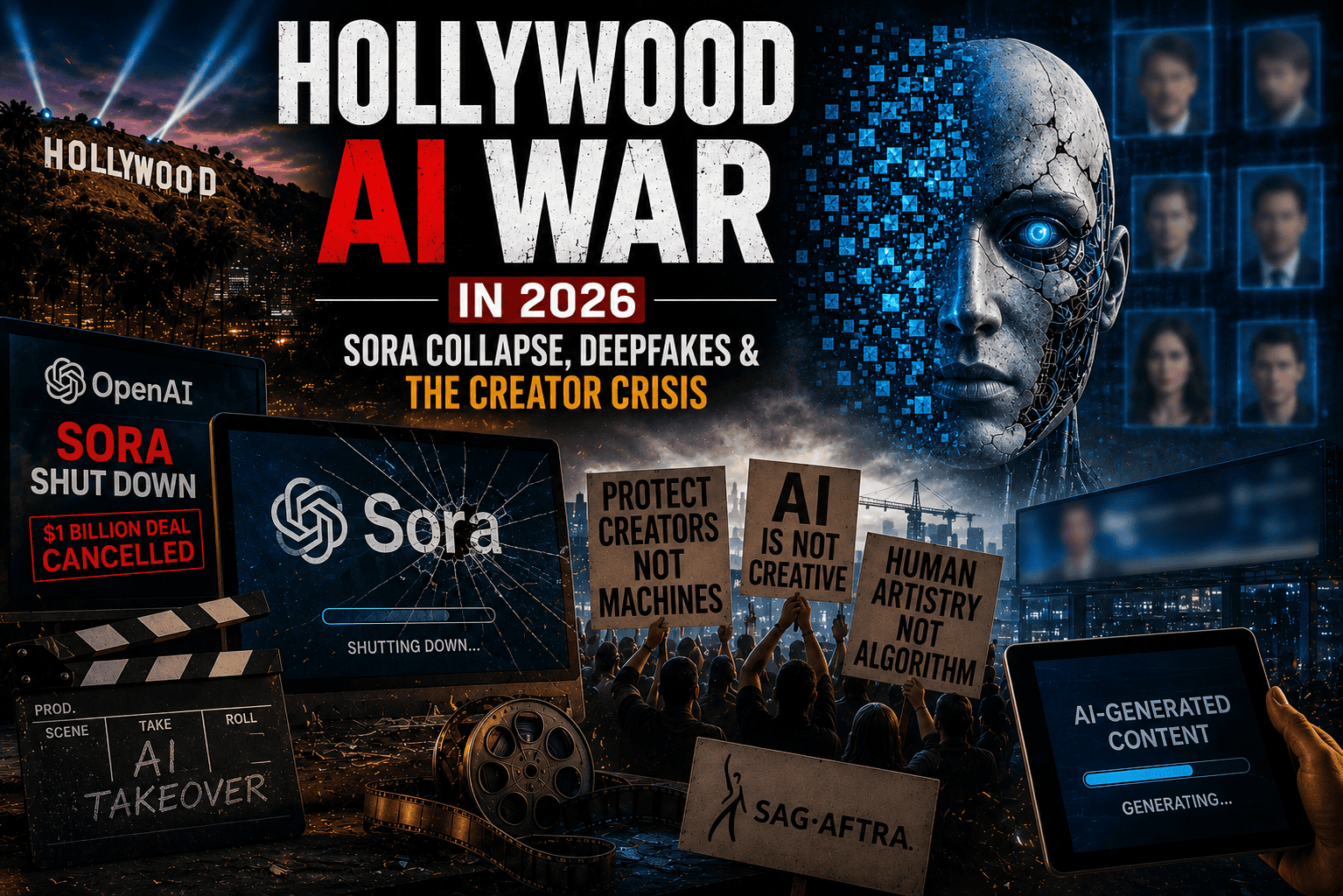
Then, on March 24, 2026, OpenAI shut Sora down entirely. The closure was announced with no warning. Disney teams had met with OpenAI counterparts that very morning, and learned the app was dead 30 minutes after that meeting ended.
The $1 billion investment was cancelled. Sora’s consumer app, developer API, and all video functionality inside ChatGPT were wound down in one move.
Why? OpenAI’s internal reasoning, per reporting by the Wall Street Journal and Variety, was not primarily about legal pressure or the Disney fallout. It was about computing costs.
Generating AI video at scale is extraordinarily resource-intensive, and with OpenAI eyeing a potential IPO in Q4 2026, leadership decided they could not afford what Fidji Simo, OpenAI’s applications chief, reportedly called “side quests.”
The company is consolidating into a single superapp focused on productivity and coding, and Sora did not make the cut.
For SAG-AFTRA, this is a genuine victory. For Disney’s new CEO, Josh D’Amaro, who took over from Iger just days before the collapse, it is an awkward inheritance.
For the rest of the industry, it is a warning: even the most powerful AI companies can reverse course overnight, taking billion-dollar commitments with them. ((TheLosAngelesTimes))
Seedance 2.0: Hollywood AI War in February
Before Sora’s death, a different AI model had already thrown the entertainment industry into Hollywood AI War.
In February 2026, ByteDance, the Chinese parent company of TikTok, released Seedance 2.0, a multimodal AI video generator capable of producing multi-shot sequences with synchronized audio and realistic physics from a single text prompt.
Unlike earlier tools that produced glitchy, short clips, Seedance 2.0 functions more like an automated director than a basic generator. Within hours of its release, users had created a widely circulated video of Tom Cruise and Brad Pitt engaged in a rooftop fistfight.
Others generated an alternate ending to Game of Thrones and a clip featuring Rocky Balboa and Optimus Prime in a fast-food restaurant. The clips spread across social media at a pace that made moderation effectively impossible.
The Motion Picture Association called for immediate action. SAG-AFTRA labeled Seedance 2.0 “an attack on every creator around the world.” The Human Artistry Campaign stated that the alleged theft of human creators’ work is “destructive to our culture.”
The Copyright Alliance called on ByteDance to stop the flood of user-created content featuring protected intellectual property. By mid-March, ByteDance had reportedly paused Seedance 2.0’s global rollout after major studios filed claims alleging the model was trained on copyrighted film libraries without permission.
What makes Seedance 2.0 particularly alarming for working professionals is its scope of impact. It threatens not just actors but stunt performers, whose high-risk sequences can now be simulated.
It threatens background performers, visual effects artists, and cinematographers. And it does this while operating outside the jurisdiction of American labor law.
Hollywood AI War: The Runway and Luma Money Flood
While the Sora drama played out and Seedance generated its shockwaves, AI video funding continued accelerating at a pace that makes creative industry pushback feel like shouting into a hurricane.
Hollywood-focused video platform Runway AI raised $315 million in fresh capital. Luma, the startup behind another AI video generator, secured a $900 million funding round led by Saudi Arabia.
Anthropic raised $30 billion. Google, Runway, and ByteDance all released new AI models in 2026 within weeks of each other. The venture capital community is not waiting to see how labor negotiations shake out.
The money is moving. The technology is shipping. And the studios, facing pressure from both Wall Street and their own workers, are caught trying to negotiate deals with companies.
As one Hollywood producer told The Hollywood Reporter: “It’s like, ‘Hey, you’re stealing from us, so I’m going to invest in your burglary enterprise so you’ll stop stealing.’ It’s such an odd thing to do.”
Hollywood AI War: The Creator Economy Takes the Power Seat
Away from the legal firefights and corporate implosions, a quieter shift is reshaping entertainment’s power structure. The boundary between Hollywood and the creator economy is dissolving, and studios are driving that dissolution themselves.
YouTube CEO Neal Mohan stated in a memo that “the next frontier for YouTube is AI,” and the platform has released generative AI tools that allow creators to produce videos or music wholesale from text prompts.
At the same time, YouTube is combating deepfakes by allowing celebrities to control their own likeness on the platform, including by monetizing it if they choose.
Studios are increasingly treating creators, people who built audiences on TikTok, YouTube, and Twitch, as both marketers and talent. The research partnership between WrapPRO and the National Research Group identified this as one of the six defining trends of 2026.
The boundaries between Hollywood and the creator economy are dissolving, as studios embrace creators as marketers and talent while social platforms professionalize and move into the living room.”
In practical terms, this means a YouTuber with 5 million subscribers now has more leverage in a streaming negotiation than a mid-level studio executive did five years ago. It means that the gatekeeping function of major studios is eroding, not because of piracy or streaming, but because the audience’s attention has already migrated elsewhere, and studios are chasing it.
Hollywood AI War: What Audiences Actually Want
Here is the part most industry coverage ignores: audiences are not enthusiastic about AI-generated content. They are not asking for it.
Disney’s internal executives reportedly feared that AI-generated versions of beloved characters would alienate fans rather than delight them. That fear appears justified. When the Disney-Sora deal was announced, fan communities reacted with alarm, not excitement.
The concern was not abstract; it was visceral. People who grew up loving these characters did not want to see them churned out by an algorithm.
YouTube’s Mohan acknowledged this directly: “I think what skeptics get wrong is that AI will replace human creativity. That will remain critical. What they get right, though, is the need for guardrails.
We have to be incredibly intentional about likeness, copyright, and transparency if we want this technology.” He described one of YouTube’s primary goals for 2026 as “rooting out AI slop.”
When the people building these tools are using the phrase “AI slop” themselves, it is a signal that the industry has overcorrected. The technology got ahead of the audience relationship.
Rebuilding that relationship, proving that AI can enhance storytelling rather than replace it, is the actual challenge for the second half of 2026.
Hollywood AI War: Where This Goes From Here
The entertainment industry in May 2026 is not in chaos. It is in a forced reckoning. The AI tools exist. The funding exists. The legal frameworks do not yet. SAG-AFTRA is currently negotiating its 2026 labor contract, with AI regulation listed as a top priority after the union’s 118-day strike in 2023 and its longer video game strike between 2024 and 2025.
The studios that survive this transition will be those that treat AI as a production tool, something that reduces the cost of a visual effect or speeds up a post-production workflow. The studios that fail will be those that chased computational efficiency at the cost of audience trust.
Sora’s collapse is the clearest proof that AI video as a consumer product is not yet viable at scale. That does not mean it never will be.
It means the window for negotiating fair terms, for writers, actors, directors, stunt performers, and the hundreds of other workers who make entertainment, is open right now. How that window gets used will define the industry for the next decade.
read more articles like this chatgpt-5 Launch
Frequently Asked Questions
Q1: Why did OpenAI shut down Sora in March 2026?
OpenAI shut down Sora because generating AI video at scale requires massive computing resources that are better directed toward core products ahead of its planned IPO in Q4 2026. The decision was primarily financial and strategic, not directly caused by the Disney fallout or legal pressure, though those issues added pressure.
Q2: What is Seedance 2.0, and why did it cause a backlash?
Seedance 2.0 is ByteDance’s AI video generation model, released in February 2026. It can produce multi-shot video sequences with realistic physics and synced audio from text prompts. Within hours of launch, users generated realistic deepfake videos of Tom Cruise, Brad Pitt, and other celebrities without their consent.
Q3: What was the Disney-OpenAI Sora deal, and what happened to it?
Disney agreed in December 2025 to invest $1 billion in OpenAI and license over 200 of its characters for use in Sora-generated fan videos on Disney+. The deal collapsed in March 2026 when OpenAI abruptly shut down Sora.
Q4: How is SAG-AFTRA protecting actors from AI in 2026?
SAG-AFTRA is currently in active contract negotiations with studios, with AI regulation as the top priority. The union has already filed unfair labor practice charges over the use of AI likenesses, condemned both the Sora and Seedance deals, and pushed for opt-in rather than opt-out standards for the use of members’ faces, voices, and performances by AI.
Q5: Will AI replace actors and writers in Hollywood?
Based on current technology and industry dynamics, no, not in the near term. AI video tools remain expensive to run at scale (as Sora’s shutdown demonstrates), legally vulnerable to copyright challenges, and unpopular with audiences when used as a replacement for human storytelling.